
The Drama of the Drakensberg
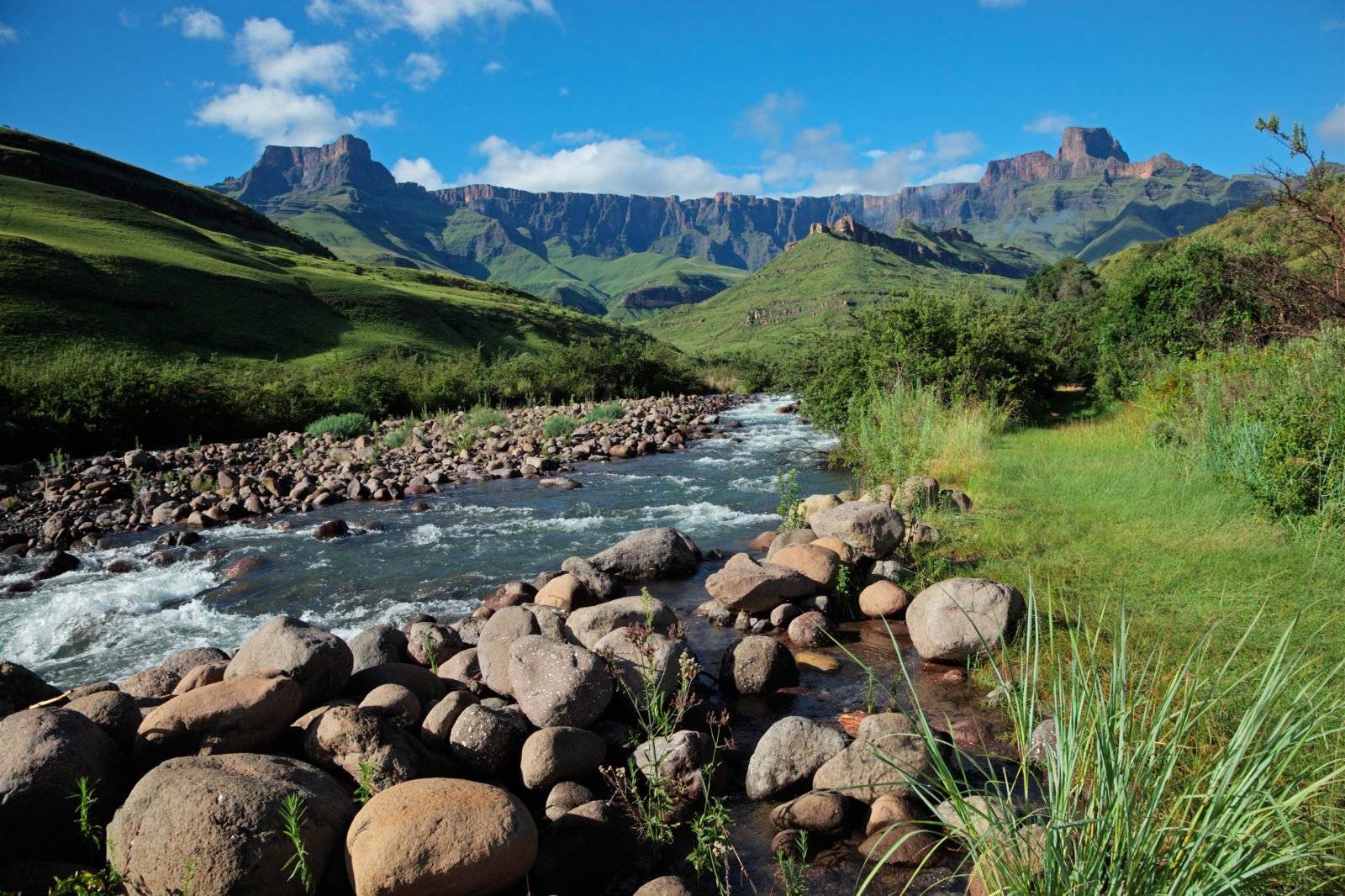
A journey into the Drakensberg — South Africa’s ancient Dragon Mountains — where basalt peaks, 40,000 San rock paintings and one of the continent’s richest ecosystems combine to create a landscape that is as humbling as it is extraordinary.
There are landscapes that snatch the words from your mouth, leaving you with little more than a sharp intake of breath, or perhaps a quiet “wow.” The Drakensberg is one of them. This ancient mountain range spans a vast stretch of eastern South Africa and remains one of the country’s least heralded crown jewels — known deeply by those who grew up near it, and not nearly well enough by everyone else.
I grew up in Durban. The Drakensberg was where we holidayed most. This sacred, sprawling landscape drew us back year after year, and yet so much of it remains unknown to me. It is vast. And it is humbling — a formidable collection of basalt peaks clambering skyward, tumbling into wild valleys cut through by restless rivers. The kind of humbling that only the grand architecture of nature can produce.
The barrier of spheres
The Drakensberg is the highest mountain range in South Africa, with peaks rising above 3,000 metres. Dutch settlers named it Dragon’s Mountain, clearly awed by its dramatic spine. The isiZulu name came long before that: uKhahlamba — Barrier of Spears. Both are linguistic attempts to capture the seismic soul of a place that resists being contained by words.
The Berg is full of names like this. Devil’s Tooth: an impossibly narrow pillar jutting into the sky. Old Woman Grinding Corn: a rounded rock that perfectly resembles a hunched figure at a mill. Monk’s Cowl: a craggy peak shaped unmistakably like a hood and habit. And then the Amphitheatre — a five-kilometre wall of convexly curving cliff face that is entirely deserving of its theatrical name.
Three regions
The Berg divides into three distinct regions, each with its own character.
The Northern Drakensberg is the domain of serious hikers — a spectacular web of high-altitude peaks, dramatic gorges and crystalline streams. Here you find the Tugela Falls, the world’s second highest waterfall, plunging over 900 metres in five cascades from the top of the Amphitheatre. The bark of baboons rebounding off ancient sandstone walls adds to the drama.
Heading south, the sentinel peaks mellow into the Central Drakensberg — the “Little Berg,” a name that shouldn’t mislead you. The mountains continue to impress, but the terrain opens up: gentler hiking routes wind through verdant valleys and indigenous forest, with swimmable river pools at the kind of picnic spots that make you want to stop time.
The Southern Drakensberg is lusher, wetter and quieter. Undulating foothills strewn with fynbos and wild proteas give way to rich grasslands — prime foraging ground for the eland, the world’s largest antelope, as well as oribi and mountain reedbuck. The Sani Pass climbs steeply for nine kilometres to the highest point in Africa accessible by vehicle, delivering you into Lesotho and views that stretch further than seems reasonable.
A living museum
In the Drakensberg, history was not written in books. It was painted on rock. The mountains contain the highest concentration of San rock art anywhere on earth — around 40,000 individual images across hundreds of caves and shelters throughout the range. These are not crude markings. They are a record of an entire civilisation: its beliefs, its rituals, its profound co-existence with the natural world, and the slow, devastating unravelling of a way of life that had endured for millennia. The earliest paintings date back more than 2,400 years. The most recent were made in the late nineteenth century, as colonial expansion pushed the San from their ancestral land — a story that moves from deep belonging to near annihilation, told entirely in ochre on stone.
Biodiverse and alive
The Drakensberg rewards those who look closely. The skies are patrolled by the endangered bearded vulture and the black eagle — presences that feel ancient, and are. The mountains support close to 300 bird species, 24 species of snake, a range of reptiles, river frogs and freshwater fish, including the Maluti redfin, a species recently pulled back from the edge of extinction. The plant life shifts vividly with altitude and aspect. For those who want to move through the landscape, the options are serious: trails range from gentle half-day walks to demanding multi-day expeditions deep into the escarpment. Mountain biking, horse riding and quad-biking offer different paces through the same extraordinary place.
Slow by design
The Drakensberg’s roads do not connect all points. Travel here is slow — and that is exactly the point. Along its bumpy tracks you pass humble settlements where barefoot children watch and wave. It is a place that demands you arrive at its pace, not yours. Compared to the heavily-trafficked destinations on South Africa’s western side, the Berg remains largely undiscovered internationally. Loved fiercely by locals. Quietly waiting for everyone else.
When to visit
Autumn (April to May) and spring (September to October) offer the best conditions — warm days, dry trails and the afternoon storms of summer behind you. July and August bring crisp, clear days and the possibility of snow on the peaks. Vigorous walks. Wood fires at the end of them.
For those open to being moved by a place as much as a view, the Drakensberg is calling.
Sindisa designs journeys into the Drakensberg for families, multi-generational groups and individuals seeking meaningful movement through one of Africa’s most compelling landscapes. Reach out to start a conversation.